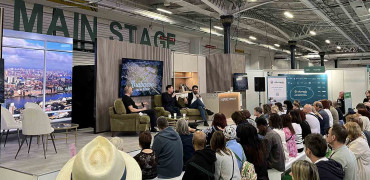
We held a conference for our customers last week, called PACE26, and as guest speaker, the audience heard from former MP, Amber Rudd, who held various ministerial posts, including Secretary of State for Energy and Climate change after the 2015 election.
The session was looking at how legislation continues to impact on HVAC and the companies that are involved in creating comfortable and sustainable places for society, whether at home, at work, or at leisure.
Amber Rudd started off explaining that whilst the private sector is very important to the nation and key to growth, it’s worth recognizing that senior politicians think very little of CEOs … and vice versa.
Both care more about their key audiences: Customers for business; voters for politicians, and both audiences have very different requirements.
The Clean Future is already here and now it is just a question of the speed of change.
Russell Jones Content and communications manager
A brief history
What they do have in common though is that both consumers and businesses require energy, so she went on to talk about how we got to where we are today, and the optimism of the time, which led to the dawning of the climate change act.
It’s worth remembering that the first decade of this century was the time of Al Gore’s ‘An Inconvenient Truth’ which shows how this all started on the left of politics but soon become a topic for all parties at the time.
The 2008 Climate Change Act was proposed by Labour, but then the Conservatives made it even more ambitious, with David Cameron campaigning in 2010 on the slogan ‘Think Green, vote Blue’.
2010 – 2015 of course was the coalition and the energy transmission was very important to both parties in the coalition. Of course, there were tensions emerging but overall everyone was onboard.
More importantly though, it was also front of mind for the public and they were also committed to tackling climate change.
A real trilemma
This presents a trilemma for the government. There is the need to:
- Reduce carbon emission
- Secure energy
- Ensure price affordability
In 2014, Amber Rudd became a Junior Minister, and the government launched its Green Deal, which tried to persuade the public to borrow money to insulate their homes. However, it never really took off and was not a great success.
In 2015, following the General Election, Amber Rudd became Secretary of State for Energy and Climate Change and represented the UK at the 2015 Paris Climate Conference, otherwise known as COP21.
This landmark UN summit saw 196 nations adopted the Paris Agreement, a legally binding treaty designed to limit global warming to well below 2°C, preferably 1.5°C, compared to pre-industrial levels. It entered into force on 4 November 2016.
The agreement saw the meeting reach a global deal on how to tackle climate change, seeking a commitment from everybody to reduce emissions.
A phonecall from God
At the time, the UK played a really important role in the European Union and President Obama was in the White House so there was certainly huge backing for a commitment.
However, there were 196 countries involved, with very different requirements and demands. Emerging nations were calling out developed countries who had forged their wealth on the back of coal, oil and gas, yet were calling on them to hold back on using fossil fuels to accelerate their growth.
After three weeks discussion it looked like there was a deal, until the Nicaraguan delegation objected and refused to sign. And it took a phonecall from the Pope Francis who persuaded the delegation that God would want them to sign.
Amber said she never thought that we could reach agreement but left COP21 really enthusiastic that the world had made a major decision, with 196 countries all agreed to make these reductions.
A more stable time
What no-one had accounted for was just how stable the world was at the time, even though it didn’t always feel that way.
Amber Rudd said that if the Paris Climate Change Agreement can ever be called a failure, it is simply because the world has changed and is a much more divisive and uncertain place.
Look to the UK, the legally binding targets mean that the government has to come back to parliament every five years and explain how the reduction is going and whether we are still on track, or not.
The Climate Change Committee oversee the Carbon Budgets and how the nation is doing. As a Tory, Amber Rudd said she was rarely quick to praise a Labour government but in this case she could see that the current government is very committed to meeting our obligations.
However, the drama of the past ten years mean that we are in a very different place and one of the things that has changed is that the public are less supportive, predominantly because of the cost-of-living crisis.
Unexpected consequences
Winston Churchill believed that energy security called for diversity but today, energy security plays into the electrification of our nation’s energy.
The Trilema for the government still exists and we also need to layer on international issues which make it more like a Rubiks Cube, where every move has unexpected implications.
So, regardless of government moves and subsidies, there are more costs on household bills and, with populists on both the left and the right spouting simplistic slogans, it is easy to blame rising costs on the Green Agenda.
What we do know though is that the current situation in the Strait of Hormuz is affecting certainly for everyone: For businesses; for consumers; and for policy makers.
We therefore see the current Tory leader calling for us to pull out of the Climate Change Agreement, and parties like Reform going even further.
The good news though is that all the work done to ‘green the grid’ and take us off oil and gas, is paying dividends and carbon removal as a momentum is now unstoppable.
The world produced 67 Gigawatts of renewable energy last year and half of that was in China, who are way ahead in terms of both supply and connectivity, and have taken a much more strategic long-term approach.
Increasing the speed of change
So, the Clean Future is already here and now it is just a question of the speed of change.
It’s worth remembering that the politicians will only do what is popular and vote winning, so businesses have an important role to play in keeping pressure on our politicians as the Hurmuz situation has shown just how volatile we are to global prices in oil and gas.
It’s all about price now and she then spoke about the spark gap and how gas only makes up about 8% of our consumption but still sets the price for electricity, which has to change. Decoupling is very important.
Amber Rudd was followed by our own Chris Newman who talked to the room about getting comfortable with change, explaining that the HVAC industry had been through lots of change over the past decades with more to come.
But that’s a topic we’ll cover in a future blog.
Russell Jones is Content and communications manager