Barely a week seems to goes by without another headline warning that AI is coming for the workforce. Lawyers, copywriters, analysts are all seemingly on borrowed time. But on an actual construction or work site, this isn't always the vibe.
Design software can generate options, check compliance and flag clashes faster than a human ever could. Offsite manufacturing and prefab is increasingly automated as we know on the factory floor, where conditions are controlled and easily repeatable.
Robotics are currently laying miles and miles of perfect brickwork, layout marking, plastering and even welding steel in a fraction of the time it once took by hand.
But wander onto site and ask an HVAC engineer if they're worried, and you'll likely get an optimistic answer.
Trades that physically assess and troubleshoot buildings in real time remain resistant to replacement
Kirsty Hammond Publisher of Specifier Review
Where AI cannot go
These engineers spend a significant amount of their working years in places no AI agent or robot will ever go. Loft spaces, plant rooms, in tight spaces on rooftops, in utility rooms or airing cupboards, in old properties and new builds.
Working out how a decades old network of tubes connects to a new system takes years of judgement. An AI model can be trained on a thousand floor plans but still not understand the actual space, the pipes, the gaps, the property.
Automation is currently having the biggest impact with tasks that are predictable and repeatable. The more physical and complex a site tends to be, the safer it is from AI. In the UK, our building stock takes many forms, not all formulaic.
Human judgement
Although modern heat pumps can run at temperatures equal to a gas or oil boiler, they offer more efficiency if they run at lower flow temperatures than old carbon-intensive boilers, so retrofitting one into a period property can mean reassessing the whole heating system, checking whether existing radiators are big enough, whether pipework needs upgrading, sometimes adding underfloor heating.
That assessment depends on physically being in the building because no two old buildings were even built the same and who knows what modifications have been made along the way.
Solid stone or brick walls (common pre-1920s, before cavity walls became standard) behave completely differently from modern buildings, insulation-wise, and heat loss calculations have to account for genuinely unpredictable factors: uneven wall thickness, hidden voids, previous botched renovations, damp, low ceilings and irregular room shapes that don't match any standard floor plan.
Routing pipework through solid walls or converted ancient lofts, working out where an outdoor unit can even go in on a site or in a garden that was never designed with modern equipment in mind, and navigating listed building or conservation area restrictions, all takes an experienced engineer to be present. A heat pump in such areas cannot be visible from the street.
Automate where appropriate
An AI system can help with the design calculations and paperwork side, but the actual assessment and installation depends on someone crouching in a loft, tapping a wall to work out what's behind it, and adapting the plan on the spot when the building doesn't match the expectation, which, in a lot of British buildings is very common.
Scheduling and compliance checks are increasingly handled by software now. Prefabrication is thriving in factory settings precisely because those environments are controlled in a way a live site rarely is.
But the trades that require getting physically inside a building to assess, adapt, and troubleshoot in real time remain stubbornly resistant to replacement.
This is not an argument for standing still or looking backwards. But rather, it raises the questions on how the industry trains and retains the people whose work cannot simply be automated away.
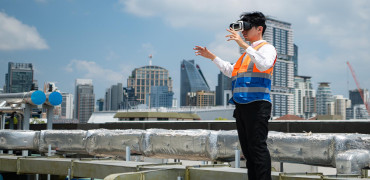
Virtual Reality is proving to be one of the most effective tools for meeting many challenges. Immersive training platforms allow engineers to step inside a heat pump, examine pipework connections and understand airflow pathways before they ever touch live equipment.
This of course builds competence and confidence in a way textbooks and classroom sessions cannot. Fault conditions, incorrect installations and commissioning errors can all be demonstrated safely, with zero real-world risk and cost implications.
Next generation
Exciting new tools like VR are also proving valuable for recruitment, helping engage a younger generation more used to interactive digital experience than static brochures or traditional presentations. This is exactly the moment the sector needs new talent to meet the future growing demand.
Robotics research keeps stalling at the same hurdle, with the same problem: dexterous, awkward, real-world manipulation and unpredictable environments. Until a robot can move around a tightly spaced plant room or crouch through a loft hatch, assess a corroded joint, and judge whether it needs replacing or simply tightening, that work will stay human.
Currently it seems machines can take on the predictable and repetitive. People can take on the judgement, the adaptability, the crawling through gaps and negotiating with a client or homeowner.
A machine was never built to reach these spots. If the industry is serious about delivering the infrastructure the country needs, technology alone won't do it. It needs the engineers to remain human.
Kirsty Hammond is Publisher of Specifier Review