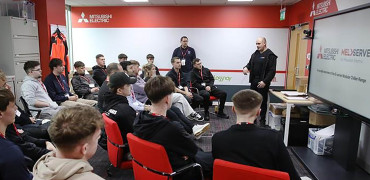
Mitsubishi Electric continues to lead the way with practical innovation applied to the built environment, through its advanced HVAC technology.
What’s less well known beyond its customers, is the way it trains and inspires engineers with its brilliant team of trainers, who have created Award-winning programmes using Virtual Reality (VR).
As construction as a whole embraces the advancements in digital technology, VR is emerging as one of the most successful tools for powerful engagement, improving safety, accessibility and efficiency.
Digital technologies are continually transforming how projects are designed and executed. Innovatively, by creating a virtual environment many construction companies can simulate operations in many projects.
VR helps builds confidence and knowledge before they ever touch live equipment
Kirsty Hammond Publisher of Specifier Review
Tomorrow has arrived
Virtual Reality in construction is no longer a futuristic concept reserved for highbrow designers. Instead, it is reshaping training, reducing costs and opening doors for the next, tech savvy generation of engineers.
Within HVAC in particular, where systems are increasingly complex and safety-critical, immersive learning is proving to be invaluable and effective.
At Mitsubishi Electric, this shift has taken shape through the gamification of HVAC training — an initiative developed by the trainers to speak to school leavers in a language they understand.
By using VR headsets, these ‘engineers of the future’ can step inside a heat pump or a huge chiller, to navigate key components and observe how systems interact, all within a fully immersive digital environment.
It is hands-on experience without the practical or physical constraints of being onsite or relying on laborious textbooks.
Honey, I shrunk the kits!
For students and engineers, the benefits are clear. Large-scale equipment and complex heat pump systems are not always accessible for training.
Physical size, cost and safety limitations can restrict any interaction.
VR removes many obstacles. Engineers can move through systems virtually, examine pipework connections and the location of circuit boards, identify correct component placement and understand airflow pathways in a way traditional classroom methods cannot replicate.
The immersive training platform allows engineers to see how connections should look, how components interact and how systems operate under different conditions.
It builds confidence and knowledge before they ever touch live equipment.
Always safety-first
For trainers, it offers something equally valuable: the ability to simulate complex scenarios in complete safety.
Fault conditions can be experienced, incorrect installations and commissioning errors can be demonstrated visually without any real-world risk or cost.
This virtual environment reduces hazards to zero while facilitating a much better understanding of the dangers involved in installing, commissioning and maintaining HVAC systems.
Safety becomes experiential rather than theoretical — a crucial advancement in an industry where precision matters.
Talk to me
Beyond technical training, VR has become a powerful recruitment tool.
Engaging school leavers and young people in engineering is essential to delivering the UK’s green ambitions. Traditional presentations and brochures cannot compete with immersive digital experiences for engagement, think of the fun factor!
By ‘gamifying’ HVAC, Mitsubishi Electric has created an entry point that resonates more with the younger, digital generations.
When taken into schools, colleges and major industry events such as Installer Show, the VR experience allows students to explore the inside of HVAC equipment as if they were inside a game environment. They can look around, interact and understand systems intuitively.
It speaks their language.
And it is working. Interest levels from young people have been increasing, whether at educational outreach sessions or customer events.
In a sector often perceived as traditional, VR can reframe engineering as innovative, dynamic and forward thinking. New talent is not just being informed about construction careers, they can now experience them.
According to the HPA, there has been a marked 14% increase in interest in the number of people being trained compared to the same time last year.
Award-winning
Mitsubishi Electric’s training initiatives have received multiple accolades, including Training Provider of the Year at the 2025 ACR News Awards and the 2025 National ACR & Heat Pump Awards, alongside Training Initiative of the Year at the 2024 HVR Awards.
These awards reflect a sustained commitment to raising standards across HVAC education.
While the wider heat pump market may not yet have expanded at the pace originally forecast, one certainty remains: the sector must prepare the skilled engineers required for long-term decarbonisation.
Recruiting, training and retaining that workforce is fundamental to achieving national targets. VR is proving to be one of the most effective training tools we’ve seen to date.
VR enables consistent and safe education. It enhances traditional learning rather than replacing it, ensuring that practical, real-world competence is underpinned by deep conceptual understanding.
Engineers emerge better prepared, more confident and more aware of safety considerations.
We talk a lot about AI and automation within construction advancements and progress is often associated with robotics or AI-driven design. Yet the key to progress lies equally in how we equip people with knowledge. Virtual Reality fills the void between complex engineering systems and accessible learning.
For Mitsubishi Electric, the future of construction technology is not just about smarter buildings — it is about smarter and more effective training.
By combining immersive digital tools with industry expertise, the company is helping shape a workforce capable of delivering the sustainable infrastructure that we need.
Because if we are serious about meeting our net zero targets, we must invest not only in technology, but also encourage the people who install it.
Through VR, gamification and Award-winning training programmes, Mitsubishi Electric is proving that innovation in construction, as with most things, starts with education.
Kirsty Hammond is Publisher of Specifier Review