Somewhere around the world robots are now laying bricks. And virtual reality headsets are appearing on construction sites across the country as a matter of course.
It sounds like the plot of a film, but it is very much the reality of where the construction industry is heading. Whether we are ready for it or not!
Robotic technology is already being deployed on site for repetitive, physically demanding tasks.
HS2 is a prime example, automated machinery is already handling excavation on one of the biggest and most complex construction projects the UK has ever seen.
Automated bricklaying machines can now lay thousands of bricks a day with consistent accuracy, whilst robotic excavators are taking on the dangerous groundwork that has traditionally put human workers at risk.
The appeal and benefits are obvious. Fewer injuries, consistent output and the ability to keep working long after hours when the rest of the site has gone home.
For tasks that are rule-based and repetitive, automation seems obvious. For the dull, dirty and dangerous, why wouldn't you?
HVAC skills are in demand, are hands-on and essentially irreplaceable at the moment
Kirsty Hammond Publisher of Specifier Review
Real training but virtually
Virtual Reality, or VR, is transforming something equally important, how we train the people doing the practical work.
Construction companies are now using immersive virtual environments to simulate site conditions, allowing workers to rehearse complex or hazardous tasks before ever setting foot on an actual site.
You can recreate a dangerous situation without any actual danger or cost implications. Workers can problem-solve, make mistakes and learn from them, all without consequence of time and money.
The health and safety benefits alone are significant, but the gains in confidence and competence are equally valuable.
Fault finding in a safe environment
In the HVAC sector, this approach to training is already proving valuable.
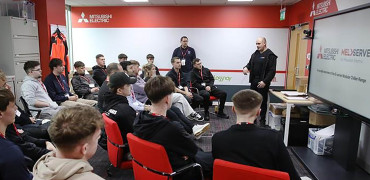
Mitsubishi Electric's training team has pioneered the use of VR to let engineers go inside equipment, exploring compressors, circuit boards and expansion valves in a way a classroom has not been able to replicate until now.
Engineers can navigate around entire systems, pause for information and troubleshoot faults in a fully immersive environment.
The work has won awards, and it is easy to see why. A generation that has grown up gaming and using a screen takes to this kind of learning instinctively and intuitively.
Crucially, it is helping to attract new talent and youth into an industry that badly needs it.
Mitsubishi Electric's training team has taken this a step further. Their award-winning VR system allows users to explore the internal workings of chillers, heat pumps and air conditioning systems up close, and is currently being taken out on the road to recruitment fairs, giving the next generation a taste of what a career in HVAC actually looks like from the inside. Quite literally!
Hands-on … for humans
But here is something interesting to consider. For all the negative talk and fear of robots and AI replacing workers, there are some jobs it simply cannot do.
A robot can lay a brick to a specification, but it cannot yet diagnose an intermittent fault on a heat pump in a draughty room, or commission an air conditioning system across a complex multi-zone commercial building.
HVAC engineering demands physical dexterity, real-time problem solving and judgement calls that no algorithm has yet come close to mastering.
So, whilst the wider construction industry and wider work force nervously watches the rise of automation, heating and air conditioning engineers find themselves in an unusually comfortable position.
Their skills are in demand; their work is hands-on and essentially irreplaceable at the moment.
The global shift towards low-carbon heating means the industry is only going to grow.
These are green jobs, future-proofed in fact, and of course exceptionally skilled.
Perhaps robots will in fact shine a light on where our value as free thinking human beings actually lies!
Kirsty Hammond is Publisher of Specifier Review