I’ve become a bit of a wind farm geek.
I never thought I’d say that, but after standing beneath those astounding turbines, with the wind roaring round me, I came away completely hooked.
This month I was officially announced as Scottish Power’s GREENER LIVING AMBASSADOR, and it genuinely feels like the right fit. For years now I’ve been talking about better homes, cleaner heating and the huge opportunity we have to move away from oil and gas and towards electrification. That is exactly why my long relationship with Mitsubishi Electric Ecodan has made so much sense to me, and why this next chapter feels connected to the same bigger story. Scottish Power is the UK’s first integrated energy company generating 100% green electricity, with 40 operational wind farms producing enough renewable power for millions of homes.
The truth is, we know the direction of travel. We know fossil fuels have done enormous damage. We know they leave countries exposed when global events turn volatile. And we know Britain has been given something extraordinary by nature, wind, sea and the chance to do something really smart with both.
The transition to cleaner energy should also be about creating opportunity for the next generation
George Clarke TV presenter, architect, writer and Ecodan Ambassador
Part of the landscape
That really hit home for me when I visited Whitelee Windfarm on Eaglesham Moor, just outside Glasgow. It is the largest onshore windfarm in the UK, with 215 turbines generating enough electricity to power more than 350,000 homes. Now those are impressive numbers. But what struck me most was not just the scale. It was the feeling of the place.
Whitelee is not just a bit of infrastructure dropped onto the landscape and forgotten about. It has become part of the life of the landscape. There is a visitor centre. There are paths and trails. People come there to walk, to cycle, to learn, to take it all in.
It feels open. It feels useful. It feels connected to ordinary life. That is important, because if we are going to build a greener future, people must feel part of it. They have to be able to see it, understand it and trust it.
I understand why windfarms can divide opinion. Of course they can. Put anything in the wrong place and people will question it. And in some of the most beautiful landscapes in the country I would have concerns too.
But in the right place, done properly, wind turbines can absolutely work. In fact, they can do more than work. They can create access, bring investment and make clean energy visible and REAL.
Massive potential
And Whitelee is only one part of a much bigger story.
ScottishPower’s onshore windfarms now stretch right across these islands, from Scotland to England, Wales, Northern Ireland and Ireland. That tells its own story. This is no longer some niche idea tucked away in one corner of the country. Wind power is already part of the landscape, already part of the energy mix, and already helping power huge numbers of homes.
Zoom out further and the national picture is even more striking. The UK now has more than 12,000 wind turbines, including around 9,000 onshore and nearly 3,000 offshore. There are 45 offshore windfarms around our coast, and together onshore and offshore wind now generate enough electricity each year to power more than 26 million homes.
That tells you something important. Wind is no longer a side conversation. It is now one of the CENTRAL PILLARS of our energy future.
Creating job opportunities
Onshore wind is massively important because it is one of the cheapest ways we have to generate new electricity at scale. The latest round of successful onshore wind projects will generate enough power for more than 1.2 million homes. That is not some fringe idea. That is COMMON SENSE.
Then there is offshore wind, which to me feels like one of Britain’s greatest opportunities. Yes, offshore wind is harder and more expensive to build and maintain. But the advantages are huge. More wind. More consistency. Bigger scale. Less visual intrusion in many cases. More engineering. More jobs. More confidence in Britain’s future.
And this is not just about energy. It is about industry, supply chains, ports and skilled work. It is about giving young people proper opportunities in trades, engineering and low carbon technology.
That matters to me enormously, because the transition to cleaner energy should also be about creating opportunity and backing the next generation
I’ll be on the Mitsubishi Electric stand at the Ideal Home Show in April
Nation-shaping
Scottish Power’s East Anglia projects show exactly what that ambition looks like in practice. East Anglia ONE is already up and running, generating enough clean electricity to power around 700,000 homes.
The wider East Anglia developments are on a scale that could power the equivalent of more than 3 million homes.
Just stop and think about that for a second. More than 3 million homes. That is not a token gesture. That is not a nice little pilot project. That is nation-shaping infrastructure.
That is where the story comes back to our homes. Because the more clean electricity we generate, the more sense it makes to use it in how we heat our homes and power our daily lives.
Demand for electricity is expected to rise sharply over the next decade and beyond, driven in large part by the electrification of heat and transport. By 2035 it could be up by 25 to 60 per cent, and by 2040 it could be as much as double.
Electric homes
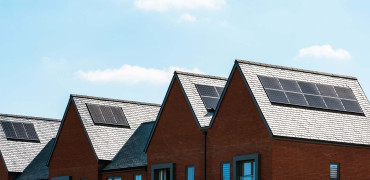
For homeowners, this is where it gets exciting. An ideal electric home is not some futuristic dream. It is a home built around a better way of doing things.
For generations, we have relied on burning fossil fuels in the house itself to keep warm and heat water. That is wasteful. It is polluting. And it belongs to an older way of thinking.
Electrification is a move away from that. It is about clean efficiency. It is about using energy better, wasting less of it, and designing homes that perform properly from the start. It is a different mindset. And it is not just better for the planet. It is a better way to live.
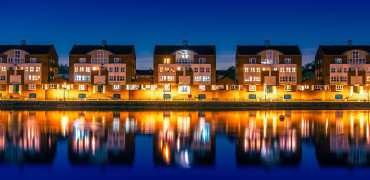
But this should not stop at the front door. What does an ideal electric community look like? For generations, the places we live have been shaped by fossil fuels. So, what does an ideal town look like when it starts to use clean energy not just to power homes, but to make everyday life better?
Maybe it means better public transport, better street lighting, safer cycling routes, greener public spaces, warmer schools, cleaner air and homes that are simply more comfortable to live in.
In the Netherlands, designers created a glowing cycle path near Eindhoven using stones that charge in daylight and glow after dark. It is experimental, yes, but I love the spirit of it. It reminds us that the energy transition should not just be about carbon and kilowatts. It should be about imagination as well. It should be about creating places that feel better.
An Ideal time
And that brings me neatly to the Ideal Home Show.
Mitsubishi Electric will be there throughout the full run of the show at Olympia London from 10 to 19 April 2026. I’ll be there on Saturday 18 April. In the morning, I’ll be joining a panel discussion with Phil and Zena, a couple who visited the Mitsubishi Electric stand last year and have since gone on to have a full Ecodan heat pump installed in their home.
I love that, because it brings everything back to real people making real choices about how they live.
Then in the afternoon I’ll be part of a second panel discussion, THE IDEAL HOME IN THE IDEAL TOWN, looking at what future communities could be if we really back good design, clean energy and proper long-term thinking.
And that, for me, is what the shift to cleaner energy should be about. Not gadgets. Not jargon. But REAL HOMES, REAL PEOPLE and REAL OPPORTUNITY.
Mother Nature has given us all we need to live in harmony with the planet. It is up to us now to harness that natural power and use it to heat and power our homes using clean, green renewable energy.
We have made incredible progress over the last 10 to 15 years. And I honestly believe the future is looking a lot brighter, and a lot greener, than many people think.
George Clarke is a TV presenter, architect, writer and Ecodan Ambassador