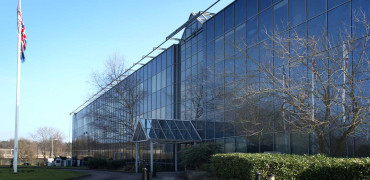
The UK office market has undergone profound changes in recent years. Hybrid working patterns and rising expectations around sustainability are reshaping how office buildings are designed, operated and refurbished.
In addition, recent updates to the Building Regulations to deliver the government’s Smart Homes and Buildings Strategy also set tighter emissions and energy use limits, along with carbon emissions factors that push both new-build and refurbishment schemes towards electrification and adoption of low-carbon heating technologies such as heat pumps.
Updating HVAC is one of the most effective ways of improving energy performance
Mike Egan Business Development Manager
Green and brown virtues
Sustainable certifications are increasingly valued in this market. Property advisers have already noted the emergence of a clear “green premium” for highly efficient buildings and a corresponding “brown discount” for less efficient stock.
Investors and occupiers favour buildings that demonstrate strong environmental performance, putting a high value on recognised voluntary certifications such as BREEAM and NABERS. The new UK Net Zero Carbon Building Standard (UK NZCBS) is also quickly gaining support from building owners and designers alike.
Office buildings that can’t keep pace with these performance expectations face the risk of becoming stranded assets: properties that lose both rental and capital value because they no longer meet market or regulatory standards.
For many office owners, therefore, refurbishment has become the most practical way to address this challenge.
Re-using existing buildings through targeted upgrades can significantly reduce embodied carbon compared with demolition and rebuilding, while also improving operational energy performance.
Difficult to maintain old equipment
HVAC (Heating, Ventilation & Air Conditioning) systems are often one of the key building components that owners are updating or replacing, and it’s a move that offers several benefits.
These systems are among the largest energy users in commercial buildings, yet they are also essential for delivering comfortable, healthy and productive working environments. Updating HVAC equipment therefore presents one of the most effective opportunities for improving energy performance while enhancing the overall quality of office space.
Recent proposed changes to the UK’s F-gas Regulation are also focusing attention on HVAC refurbishments. The proposal to fast-track the phase down of higher GWP refrigerants has some critical implications for office building operators.
Phase downs will reduce the availability of higher-GWP refrigerants used in older air conditioning systems – making them harder and more expensive to access for future maintenance. As a result, upgrading to systems using lower-GWP alternatives becomes increasingly attractive.
Together, these regulatory developments create a clear inflexion point. For buildings with HVAC systems approaching the end of their operational life, replacing equipment now can help future-proof the asset against both regulatory change and rising operating costs.
Several advantages
While there are significant ‘push’ factors for retrofitting HVAC systems, refurbishment or replacement offers several advantages for office buildings.
Modern HVAC systems are significantly more energy efficient than equipment installed a decade or more ago. Improved compressors, heat recovery technologies and advanced control systems allow buildings to deliver heating and cooling more efficiently.
Retrofitting therefore provides an opportunity to reduce both operational and embodied carbon.
By installing systems with lower-GWP refrigerants and higher efficiencies, building owners can reduce emissions associated with energy use and refrigerant GWP while aligning with emerging sustainability standards.
A flexible choice
Flexibility has also become particularly important as hybrid working reshapes office use. HVAC systems now need to adapt to fluctuating occupancy levels, varying heat loads from equipment and differing requirements across floors or zones of a building.
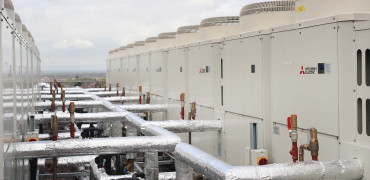
Variable Refrigerant Flow (VRF) systems have long provided a flexible solution for these environments. Modern VRF systems using lower-GWP refrigerants such as Mitsubishi Electric’s R32 range can deliver high levels of efficiency while helping buildings meet evolving environmental requirements.
Mitsubishi Electric’s Hybrid VRF (HVRF) system also offers an additional option for refurbishment projects. These R32-based systems combine the efficiency and zoning capabilities of VRF technology with a water-based distribution network within the building.
In a Hybrid VRF system, refrigerant is contained within the outdoor unit while heating and cooling are delivered indoors via water circuits.
This approach can simplify retrofit projects, particularly where concerns about refrigerant volumes or building safety regulations might otherwise limit system design.
For office refurbishments carried out in phases, HVRF systems also provide a practical pathway to upgrading heating and cooling floor-by-floor while maintaining building operations.
Comfort and wellbeing
While energy and carbon performance are major drivers of refurbishment, the indoor environment remains just as important. HVAC systems play a central role in delivering good indoor air quality, thermal comfort and occupant wellbeing – all important in today’s competitive office sector.
Modern HVAC systems integrate more effectively with building management systems, enabling facility managers to monitor performance and optimise energy use in real time.
Data from these systems can help building operators identify inefficiencies, adjust settings and ensure equipment operates only when required.
Time to act early
The UK office market continues to evolve as organisations reconsider how and where they work.
Although hybrid working has reduced overall demand for office space in some locations, it has also intensified the focus on quality. Occupiers increasingly favour buildings that offer high levels of comfort, sustainability and operational efficiency. For many existing buildings, meeting these expectations will require targeted refurbishment.
HVAC systems are central to this process. Updating heating and cooling equipment can significantly improve building performance while supporting compliance with emerging regulations and sustainability standards.
For commercial building owners, the message is clear: the time to consider HVAC upgrades is now.
Acting early allows refurbishment projects to be planned strategically, delivering energy savings, improved occupant comfort and long-term protection of asset value in a rapidly changing office market.
Mike Egan is Business Development Manager