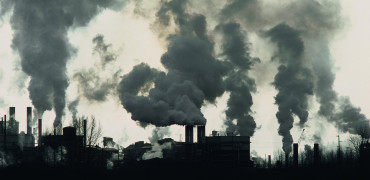
I saw an article recently, with the Press headline: “Summer of truth – Climate chaos has been shocking. Yet the respone? Tepid”.
This is after the hottest summer on record and during a super El Nino, so when you stop and think about it, are we all in danger of becoming like Emperor Nero and fiddling while Rome burns?
The online version however, carried the headline “Burning forests, emptying rivers, €180bn in damage: Europe’s politicians face reckoning after ‘summer of truth’”
Reading the article reminded me of the Douglas Adams sci-fi series ‘The Hitchhikers Guide to the Galaxy’.
The ultimate guide to getting free rides on intergalactic spaceships, comes with the words 'DON'T PANIC' written in ‘large, friendly letters on the cover’. The story also explains that although the Guide has many glaring (and occasionally fatal) inaccuracies, the words are there to provide reassurance.
Perhaps this is our collective response to what we see unfolding around us?
How very British!
We’ll watch climate change disasters on our phones until suddenly, we're the ones filming it!
Russell Jones Content and communications manager
So long and thanks for all the fish
The title of this section comes from what the book describes as the second most intelligent lifeforms on earth – dolphins, and is their final message to humans as they leave. Before you ask, mice are the most intelligent lifeforms but then you will need to read the book to find out why.
There is a lot to commend in the Hitchikers series, which is both funny and thoughtprovoking. It started life on BBC Radio and was first broadcast in the 1970’s. This lead to a publishing deal, a TV series, and finally a 2005 film staring Martin Freeman.
For me, the radio series is still the best way of enjoying the story which follows a human called Arthur Dent (played by Freeman in the film), who manages to avoid the destruction of the earth when his best friend, Ford Prefect, is revealed to be a writer for the Hitchikers Guide and manages to get them both off the planet before its is demolished to make way for an intergalactic highway.
Perhaps the Hitchhikers Guide is where the world’s first trillionaire, Elon Musk, gets his ideas from as he seems bent on finding ways off this planet before we ultimately destroy it.
As a known fan of the Guide, he even had the words ‘Don’t Panic’ displayed on the dashboard of the cherry-red Tesla Roadstar that was launched into orbit on a Falcon heavy rocket in 2018.
Closer and closer
I was also reminded of the following quote, which I often see on Twitter (X) and which is attributed to a 2022 post by @PerthshireMags:
"Climate change will manifest as a series of disasters viewed through phones with footage that gets closer and closer to where you live, until you're the one filming it.”
As we sit here in the UK at the beginning of October, with hosepipe bans still in force and everyone hoping for a bit more sunshine before Autumn proper kicks in, it looks likely that we will then face floods and a harsh winter.
Meanwhile, as the southern half of the planet makes its way out of spring into their summer, we will likely see a repeat of the drought, fires and devastation that we have endured over our summer.
So what can we do until Elon builds us a way off this planet?
Time for a pause
Well, one thing we shouldn’t do is seek advice from another character from the Hitchiker’s Guide, Marvin the Paranoid Android, who is a depressed robot with a brain the size of a planet – frustrated at all the menial tasks he is constantly given.
“It gives me a headache just trying to think down to your level,” is one quote but when asking about the climate crisis he is more likely to say: “I could calculate your chance of survival, but you won’t like it.”
Instead, I think we all need to pause, take a breather and look around for any positives.
Are there any positives?
The UK was the first country to set legally binding net zero targets, so that is now the law and, despite all the populist nonesense about ‘net stupid’ this will not be overturned unless something dramatic happens politically.
Around 145 countries in all – representing around 90% of global greenhouse gas emissions have adopted or are actively considering net zero pledges and 37 other countries have officially gone down the legal route with some, such as Sweden and Germany, setting earlier targets of 2045.
That represents an expansion from less than 30 countries making such commitments in 2019.
Beyond national governments, thousands and thousands of inidividual cities and companies have made their own net zero commitments.
However, there is still a long way to go and as this article highlights, not all net zero targets are equal.
Greening the grid
Here in the UK, we have come a long way already with renewables generating 52.5% (152.5 terawatt hours) in 2025, and this is only going to get higher as we wean oursleves off gas and oil.
Last year was the second year in a row that renewable sources exceeded 50% of our total annual electricity generation.
You can track the live generation numbers via the National Grid website here.
This move towards cleaner forms of energy is replicated across the world, as reported here.
The article reports how the climate crisis has driven innovation, policy shifts, and a rapid transition toward clean energy. This shows record growth in both wind and solar power, which grew globally by 31% last year. At the same time, fossil fuel use dropped below 50% of energy production in the US last year, so, despite the rhetoric coming out of the White House, countries are moving in the right direction.
In a report produced by the University of Exeter, ‘tipping point science’ was applied to 51 priority areas across five environmental goals: protecting nature, cleaning the air, reviving oceans, eliminating waste and tackling the climate crisis.
According to the report author, Steve Smith, the “global shift towards clean electricity could trigger a ‘cascade’ of progress, helping reduce air pollution, cut waste and revive oceans.”
“The cascade of clean energy that we’re seeing now is just doing so much more than anybody expected even 10 years ago,” he said, pointing to how these positive tipping points could be understood as the beneficial counterpart to dangerous climate thresholds, such as the collapse of ice sheets or the death of coral reefs.
So we are seeing positive moves in both renewable energy production and innovation.
So the question then becomes whether we are moving fast enough!
To answer that, I think we need to ponder it over another ‘British’ reference in the Hitchhikers Guide: Anyone fancy a really nice cup of tea?
Russell Jones is Content and communications manager