The i-Newspaper carried a headline last week stating that ‘Household energy bills won’t fall until Britain embraces heat pumps’.
While I agree that we need to do something to increase the use of heat pumps in UK homes, the article missed the real chance to fully convey the opportunity by including the word ‘Household’.
We mustn’t forget that there are two million commercial buildings in the UK which are a long-overlooked part of the UK’s clean energy push.
They account for almost half (42%) of the country’s total carbon output, yet the sector has received little to no governmental, regulatory or legislative incentive to help decarbonise.
The Warm Homes Plan was a step in the right direction for households. The same urgency now needs to be applied to the commercial sector.
The test must be whether commercial buildings can decarbonise without facing high energy costs
Chris Newman Net Zero Design Manager
Buildings over 1,000 m2
So last week’s Government announcement on its intention to strengthen the Minimum Energy Efficiency Standards (MEES) for the private rented commercial sector, is a step in the right direction and something we have strongly supported since the original consultation back in 2021.
The targeted approach requires all private rented buildings over 1,000 square metres in England and Wales to achieve EPC B by 2031. This move seeks to deliver the greatest benefits and bill reductions for tenants in larger buildings, which are responsible for 60% of electricity consumption and 70% of gas consumption in the UK.
However, buildings over 1,000 m2 account for around 7% of non-domestic buildings, so there is concern that such a narrow scope may not deliver the level of impact required to decarbonise existing building stock at the pace required.
Looking at Carbon Budget 5, 6, and now 7, it’s clear that buildings have a vital role to play in decarbonising society. Of the two million commercial buildings in the UK, only around 100,000 are larger than 1,000 square metres.
I think the government therefore needs to focus on how to incentivise and push the remaining 93% of non-domestic buildings, which will continue to be subject to the existing minimum standard of EPC E.
Electrifying heating
We know highly efficient, electrically driven HVAC systems such as heat pumps can have a huge and positive impact on improving EPC ratings.
Dropping the target of an EPC C rating by 2027 and only targeting larger buildings does grant landlords and occupiers of smaller buildings more time and flexibility to implement energy efficiency measures.
However, I think that misses a real opportunity to push and incentivise the commercial sector to accelerate energy efficiency and decarbonisation.
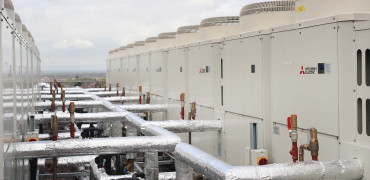
There are also landlords and companies that are already way beyond legislation, as they look to satisfy investors and tenants that are crying out for proven sustainability, such as this example in Manchester’s Exchange Quay.
The Spark Gap
Also, while legislative change is a good first step, its impact will be limited unless commercial buildings can decarbonise without being punished by high energy costs.
The government has rolled out the stick for large buildings, but it can’t forget the carrot – which can dramatically increase the decarbonisation programme.
By rebalancing the cost of electricity, we can support the adoption of low-carbon technologies and ensure that the trajectory to an EPC B rating by 2031 is commercially viable for all landlords rather than an unmanageable financial penalty.
We are heading for an electric economy, which is why decarbonsing housing is so important, but we should also embrace the opportunity to tackle the commercial sector.
If the UK really wants to compete globally, it must make electrification work in the offices, shops and everyday commercial buildings already underpinning the economy. Get that right, and the UK builds stronger foundations for clean growth. Get it wrong, and we risk playing catch-up for years to come.
The real test of widespread electrification must be about whether ordinary commercial buildings can decarbonise without being punished by high energy costs.
Clean power only drives growth when companies can use it to cut costs, reduce emissions and support the UK economy.”
Chris Newman is Net Zero Design Manager